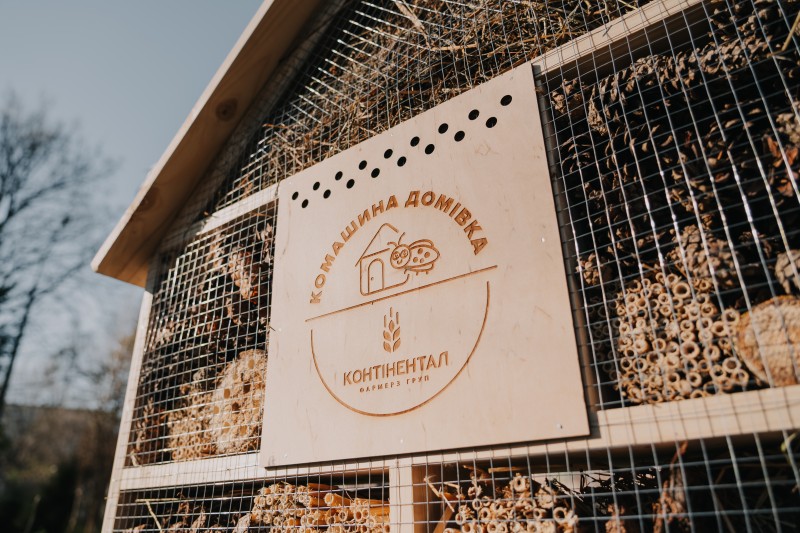
Continental is starting with itself: the Insect Home project will launch at the Company’s own production sites, after which it will expand to schools in the communities where it operates across five western Ukrainian regions. Thanks to the partnership support of the Government of the Kingdom of the Netherlands, the project will scale up to the national level, so Continental insect houses will appear throughout Ukraine.
Insect hotels are custom-made by the company using eco-friendly materials. They feature various sections designed to support natural pollinator populations: hollow stems for solitary wild bees, drilled wooden blocks, and natural materials for various species of beetles and other insects. Each structure is designed for year-round use and requires minimal maintenance.
In addition to its environmental benefits, the Insect House also serves an educational purpose. By scanning the QR code on each house, students gain access to an interactive educational platform with information about the lives of insects and their role in nature. Students will care for the insect houses, replacing materials with new ones over time. They will be able to observe the life cycles of beneficial pollinators firsthand and understand the value of each insect to the overall ecosystem and its biodiversity. In this way, the insect houses also become living classrooms under the open sky. Students will even be able to grow a variety of grasses near the houses for their charges — location is crucial for the effectiveness of the insect houses: ideally, there should be nearby areas with a rich variety of plant species that provide food (nectar and pollen) for the insects.
“Insect hotels are a common practice in European countries, where they serve as a tool for environmental education for children and are part of the concept of sustainable development,” says Nonna Shmidik, Director of Communications and Social Projects at Continental. “There, such initiatives are primarily implemented by municipalities and educational institutions. We, however, decided to adapt this beneficial practice to Ukrainian realities and integrate it into our own corporate social responsibility policy, as the ‘Insect Home’ project fully aligns with Continental’s values.”
Throughout 2026, as part of Insect Home, Continental Farmers Group plans to install over fifty insect hotels in various communities. Communities wishing to join the project must fill out an application form. Initiative groups can also build an insect house on their own using the detailed instructions on the project’s website.